
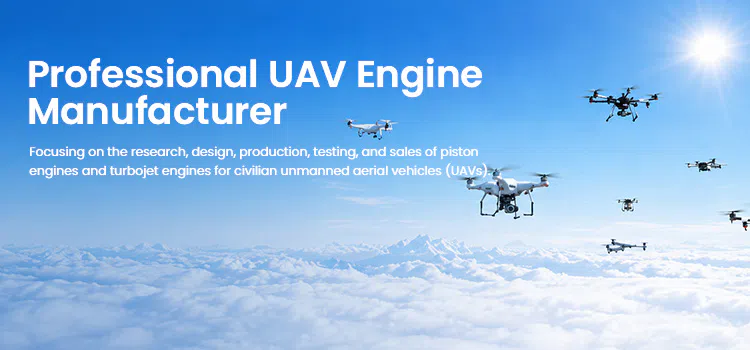
Advanced Manufacturing and Diversified Civil Application Case of Micro UAV Turbojet Engines
1. Factory R&D Orientation and Core Technical Layout of Shandong Zhongtian Power Technology Co., Ltd.
Shandong Zhongtian Power Technology Co., Ltd. has built a professional micro gas turbine manufacturing base focusing entirely gas turbine manufacturing base focusing entirely on the R&D, precision production and full-condition verification of civilian-grade UAV turbojet engine products. Different from the piston engine production line introduced in our previous industrial case, this jet engine workshop adopts ultra-high temperature resistant processing standards and closed thermal cycle testing systems, covering an area of 8,200 square meters with independent fluid simulation laboratories and high-temperature aging test cabins.
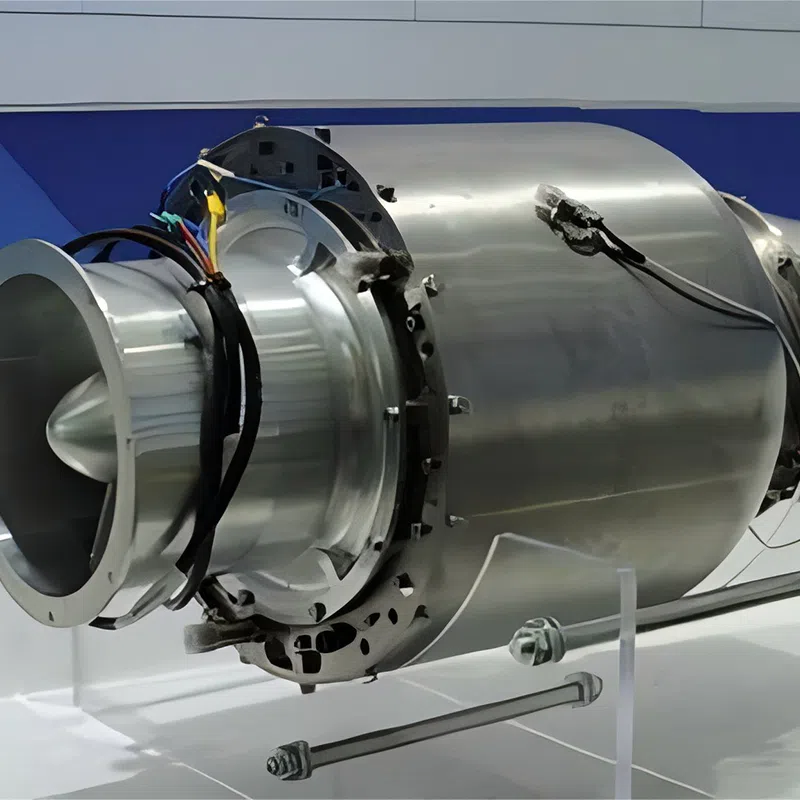
The company’s UAV turbojet engine product portfolio covers 5kgf to 120kgf thrust grades, all locked for 100% non-military commercial and scientific research scenarios. The core competitive edge of this UAV turbojet engine lies in ultra-small volume, low vibration operation and outstanding high-altitude high-speed performance, effectively filling the performance gap of electric propulsion and internal combustion piston engines in ultra-high altitude, rapid response and high-speed cruise industrial drone missions. The in-house engineering team applies CFD aerodynamic simulation and finite element thermal stress analysis to optimize the single-stage centrifugal compressor and swirling combustion chamber structure of each UAV turbojet engine, equipped with self-developed FADEC full digital control system to realize intelligent cold start, real-time exhaust temperature feedback and automatic overheat protection, greatly improving operational safety for end users.
2. Unique Precision Manufacturing and Thermal Calibration Process for UAV Turbojet Engines
The production flow of UAV turbojet engine involves high-temperature alloy processing and strict thermal dynamic testing, which is completely differentiated from the machining logic of piston UAV power units, forming seven exclusive standardized procedures at Zhongtian Power’s factory.
First, superalloy blank forging and 3D additive manufacturing. Hot-end core parts including turbine wheels, combustion liners and nozzle rings are forged with nickel-based heat-resistant alloy, while complex flow channel structures of the UAV turbojet engine are produced via industrial metal 3D printing to reduce assembly gaps and airflow loss.
Second, five-axis linkage ultra-precision machining. Rotating core components are milled with micron-level tolerance control, ensuring the dynamic balance foundation for the UAV turbojet engine running at over 100,000 revolutions per minute.
Third, Class 100,000 constant temperature and dust-free modular assembly. Technicians assemble fuel atomization nozzles, ignition exciter and high-speed starter in a dust-isolated environment to avoid tiny particle abrasion inside the high-speed rotating UAV turbojet engine.
Fourth, static ignition and thermal cycle bench test. Each finished UAV turbojet engine undergoes 150 hours of continuous kerosene burning test in an insulated test cell, simulating rapid temperature rise and sustained high-load working status.
Fifth, high-altitude environmental chamber simulation. The factory’s low-pressure test cabin replicates 13,000-meter thin-air conditions to calibrate thrust attenuation and fuel consumption parameters of the UAV turbojet engine under extreme altitude.
Sixth, vibration and electromagnetic compatibility detection. Professional instruments test the micro-vibration value of the UAV turbojet engine to guarantee interference-free operation of high-precision aerial sensors.
Seventh, parameter solidification and customized interface adaptation. Engineers solidify ECU control programs according to client demands and reserve CAN bus and analog signal ports for seamless connection with various industrial UAV flight control systems.
3. Three Exclusive Civil Industrial Application Cases of Factory-Built UAV Turbojet Engines
The batch-produced UAV turbojet engines have been deployed in three high-value civilian fields that cannot be easily replaced by piston engines, with complete practical operation data and client feedback.
The first core scenario is wildfire emergency monitoring and disaster assessment UAVs for forestry and environmental protection departments. A provincial ecological protection bureau adopted the 45kgf UAV turbojet engine to power a fixed-wing emergency response drone. This jet-powered UAV can break through strong updrafts above mountain wildfires, fly at a maximum speed of 310km/h, and transmit real-time thermal imaging and fire spread trajectory data to ground command centers. The stable high-altitude thrust of the UAV turbojet engine enables the drone to circle above fire zones for 40 consecutive minutes, greatly lowering safety risks for ground inspection staff.
The second typical application is high-speed long-distance cross-regional logistics delivery VTOL UAVs. A regional logistics technology company customized compact UAV turbojet engines for its autonomous cargo drone fleet, which is used to transport medical supplies, emergency living materials and maintenance parts to remote mountain villages, island communities and post-flood blocked areas. The rapid climbing and high-speed cruise capability of the UAV turbojet engine cuts delivery time by more than 60% compared with propeller-driven cargo drones.
The third professional usage is university aerospace dynamics experimental platforms and aviation science popularization exhibitions. Many aerospace colleges purchase small thrust UAV turbojet engines to build test rigs for fluid mechanics, turbine thermodynamics and jet propulsion teaching experiments. Aviation science museums also install these UAV turbojet engines on static display racks with transparent casings, allowing visitors to intuitively observe the internal working principle of gas turbines for public science education.
4. Future R&D Iteration and Global Service Plan
Against the backdrop of growing demand for high-performance commercial unmanned aircraft worldwide, the market demand for lightweight, low-noise and long-service-life UAV turbojet engines keeps rising steadily. Shandong Zhongtian Power Technology Co., Ltd. will continue to invest in ceramic matrix composite material upgrading, low-noise exhaust structure optimization and predictive fault diagnosis algorithm development for UAV turbojet engine products.
Adhering strictly to the full-civilian development principle without any military-oriented design or application, the factory will further streamline OEM and ODM customized production workflows, shorten prototype delivery cycles for global partners, and provide reliable, energy-efficient and cost-effective micro turbojet propulsion solutions for environmental protection institutions, logistics enterprises, university research labs and aviation science education organizations across the globe.


