
Product Overview
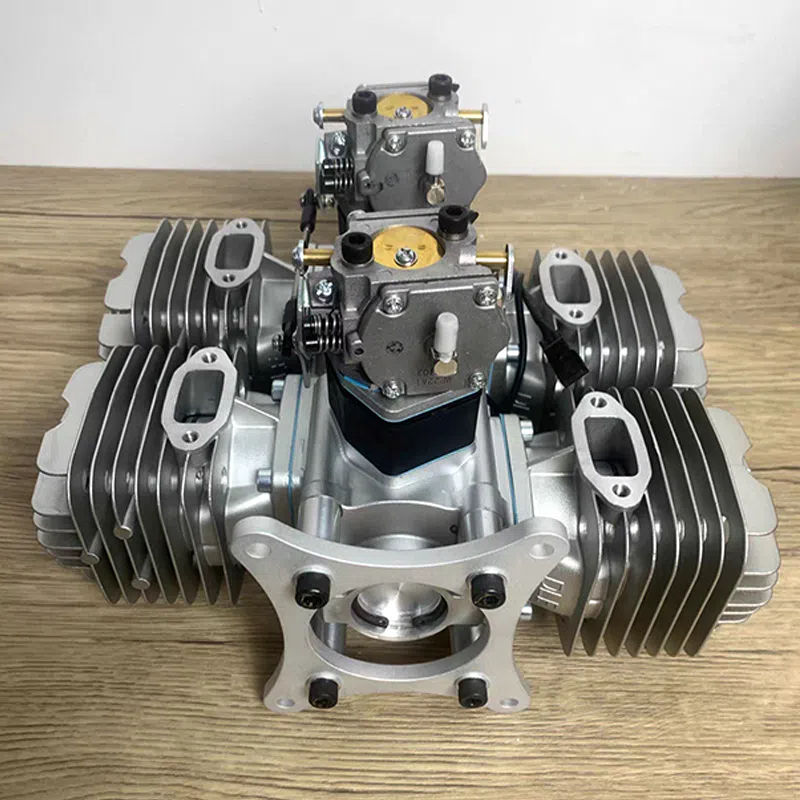
The GTF550-EFI is an industrial-grade two-stroke electronic fuel injection aviation power unit, specially customized for large heavy-lift commercial UAVs, cargo delivery drones and ultra-light experimental aircraft. With a total displacement of 550cc and horizontally opposed four-cylinder air-cooled architecture, it combines EFI intelligent fuel control, low-vibration mechanical balance and integrated power generation function.
Different from traditional carburetor drone engines, the built-in EFI module optimizes combustion efficiency and throttle linearity, delivering smooth and sufficient thrust during takeoff, climb and cruise phases. The whole engine adopts lightweight high-strength aluminum alloy structure and precision aviation manufacturing process, adapting to complex outdoor working environments such as mountainous areas, coastal zones and high-altitude regions, becoming a mainstream power choice for long-endurance commercial aerial operations.
Main Performance Highlights
1. Electronic Fuel Injection Intelligent Control System
The GTF550-EFI is upgraded with professional aviation electronic fuel injection system, replacing traditional mechanical carburetors. The ECU monitors real-time engine RPM, intake air pressure and temperature, automatically adjusting fuel injection volume to maintain optimal air-fuel mixture ratio. This design solves the power attenuation problem of carburetor engines at high altitude, reduces fuel consumption by about 12%, and realizes stable idle speed without manual tuning. Paired with ACDI automatic advance angle capacitor discharge ignition system, it ensures high ignition success rate under low-temperature and thin-air conditions.
2. Low-Vibration Horizontally Opposed Four-Cylinder Structure
The four-cylinder horizontal opposed layout achieves natural mechanical balance, greatly reducing engine vibration transmitted to the airframe and airborne precision equipment. Every key moving component adopts advanced processing technology: cylinder inner wall with Ni-SiC wear-resistant coating (service life up to 500 flight hours), liquid nitrogen precision forged crankshaft, CNC needle roller bearing connecting rod, effectively improving structural strength and wear resistance. The wide usable RPM range of 800–7000rpm covers all full-flight working conditions, with sensitive and linear throttle response.
3. All-in-One Electric Start & Stable On-Board Power Supply
Supporting 22.2V (6S) lithium battery one-key electric start, operators can complete startup without complex manual preheating steps. An integrated permanent magnet generator is embedded inside the engine, outputting steady DC 28V / 1000W power at 5500rpm. The continuous power supply can drive multi-sensor inspection payloads, long-distance communication modules and cooling auxiliary equipment, simplifying the overall wiring design of UAV airframes and reducing extra weight brought by independent power supply units.
4. Wide Environmental Adaptability & Standardized Matching
The engine stably works within the temperature range of -25℃ ~ 60℃, adapting to cold plateau, high-temperature desert and humid coastal operation environments. It supports three mainstream two-blade propeller specifications: 30×25, 32×20, 33×20, with standardized mounting flange interface compatible with most large fixed-wing and VTOL drone airframes on the market. Customized calibration and accessory matching services are available for special industrial aerial projects.
Complete Technical Specification Table
| Technical Parameter | Verified Standard Value |
|---|---|
| Product Model | GTF550-EFI |
| Engine Type | 4-Cylinder Horizontally Opposed 2-Stroke Air-Cooled EFI Aviation Engine |
| Total Displacement | 550cc (137.5cc per cylinder × 4) |
| Bore × Stroke | 58mm × 52mm |
| Usable RPM Range | 800rpm – 7000rpm |
| Peak Power Output | 50HP / 37kW @ 7300rpm |
| Dry Engine Weight | 18.5kg |
| Ignition System | ACDI Automatic Timing Capacitor Discharge Synchronous Ignition |
| Starting Mode / Voltage | One-key Electric Start / 22.2V (6S LiPo Battery) |
| Built-in Generator Output | DC 28V, 1000W @ 5500rpm |
| Recommended Propeller Size | 30×25 / 32×20 / 33×20 (Two-blade) |
| Cylinder Material | Aluminum Alloy Casting, Inner Wall Ni-SiC Electroplated |
| Operating Ambient Temperature | -25℃ ~ 60℃ |
| Applicable Fuel | 95# Unleaded Gasoline + Fully Synthetic 2T Lubricating Oil |
| Fuel-Oil Mix Ratio | 35:1 |
Common Application Scenarios
- Large payload logistics & cargo delivery fixed-wing drones
- Long-endurance aerial mapping, topographic survey UAVs
- Large-area agricultural plant protection & pesticide spraying drones
- Industrial pipeline, power line, bridge inspection aircraft
- Meteorological monitoring, environmental data collection UAV platforms
- Lightweight experimental civil aviation test aircraft
Packaging & Global Shipping
We offer full set international logistics services to deliver engines safely worldwide, available delivery carriers include:
- EMS
- FedEx Express
- DHL
- UPS
Each engine is packed with customized shockproof foam and reinforced wooden case to avoid collision damage during long-distance sea and air transportation. Our sales team can provide exclusive shipping quotation, delivery cycle and customized packaging solutions upon your inquiry.
Frequently Asked Questions (FAQ)
Q1: What is the difference between this EFI UAV gasoline engine and traditional carburetor drone engines?
A: This UAV gasoline engine adopts electronic fuel injection controlled by ECU, which automatically adjusts fuel delivery according to altitude and temperature, no manual tuning needed. It features higher combustion efficiency, lower fuel consumption and stable power output at high altitude, while carburetor engines easily suffer power drop and unstable idle speed when flying at high elevations.
Q2: Can this drone gasoline engine power multiple heavy-duty payloads simultaneously?
A: Yes. This drone gasoline engine integrates a built-in 1000W DC 28V generator, which can continuously supply power for flight control systems, high-definition survey cameras, data transmission modules and auxiliary cooling devices at the same time. It removes the need to install an extra independent generator or large auxiliary battery, optimizing the payload space and weight of the UAV.


